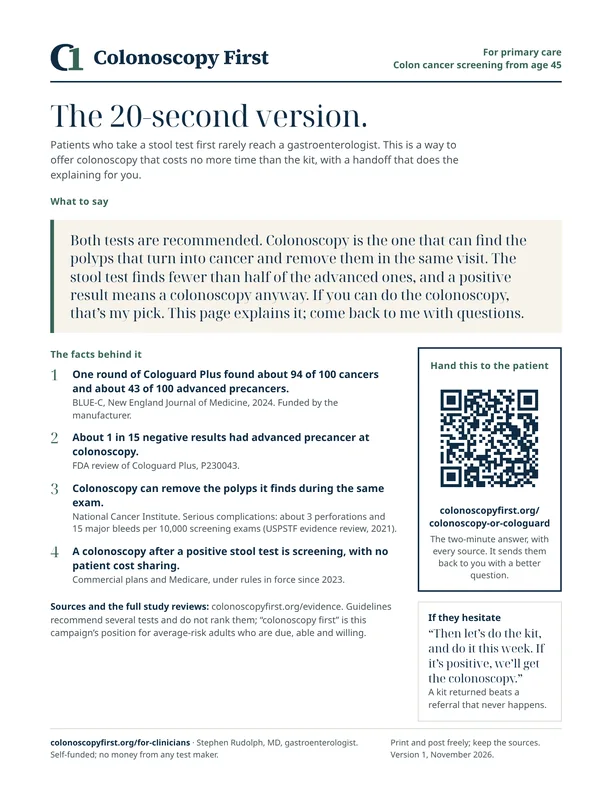
The 20-second card.
The script, the three facts behind it with their sources, what to say if the patient hesitates, and the QR code to hand over. Keep one in each exam room.
One page · Version 1 · November 2026

For clinicians
Your patients turning 45 are often offered a stool test first, and most of the ones who take it never meet a gastroenterologist. Here is a way to offer colonoscopy that costs you no more time than the kit does.
For primary care clinicians, nurses, medical assistants and clinic managers. Everything on this page can be printed, posted and shared in a clinic without asking.
 From Stephen Rudolph, MD, a practicing gastroenterologist. Self-funded, with no money from any test maker. Reviewed November 2026.
What to say
“Both tests are recommended. Colonoscopy is the one that can find the polyps that turn into cancer and remove them in the same visit. The stool test finds fewer than half of the advanced ones, and a positive result means a colonoscopy anyway. If you can do the colonoscopy, that’s my pick. This page explains it; come back to me with questions.”
Then hand over the card, or point at the QR code on it. The site does the explaining, so you don’t have to.
“Then let’s do the kit, and do it this week. If it’s positive, we’ll get the colonoscopy.”
A kit returned beats a referral that never happens. The point is not to talk anyone out of a stool test. It is to make sure the patient who would have said yes to a colonoscopy gets asked.
Why the handoff works
In a 2025 preference study sponsored by the maker of Cologuard, colonoscopy was the predicted choice of 95% of physicians. Among patients, the stool DNA test led, at 39%. Only the physicians’ questions included how well each test finds precancer.
That gap is information, not stubbornness. The two-minute comparison gives a patient the same two numbers you already carry in your head, then sends them back to you with a better question.
The preference study and its limitsWhat each group was shown
The scorecard
The colorectal screening quality measure counts a stool test within the year, a stool DNA test within three years, or a colonoscopy within ten as “screened.” That is a participation measure, and participation is worth measuring: about one in three eligible adults is not up to date.
It is not a measure of precancer found or removed. Nothing about the score tells a patient that the two tests differ, so unless the visit does, many assume they are equal.
The Checkbox Problem, as a posterThe measure, as plans describe it to clinics
Print and post
Every number on them has a source on this site. Keep the attribution and the sources, and use them as you like. For a waiting-room screen, the short films run with captions and without sound.
The script, the three facts behind it with their sources, what to say if the patient hesitates, and the QR code to hand over. Keep one in each exam room.
One page · Version 1 · November 2026
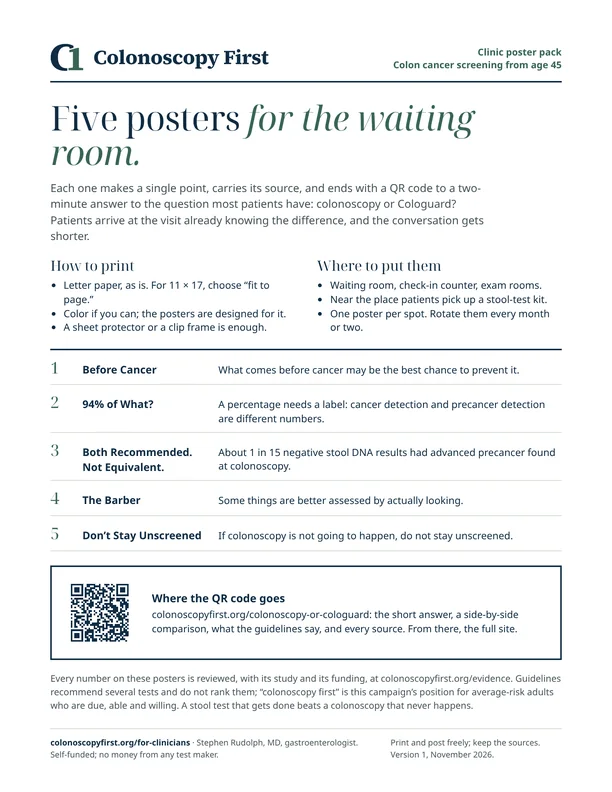
Each one makes one point, carries its source, and ends with a QR code to the two-minute answer. Prints on letter paper or 11 × 17. A cover page explains how to use them.
Six pages · Version 1 · November 2026
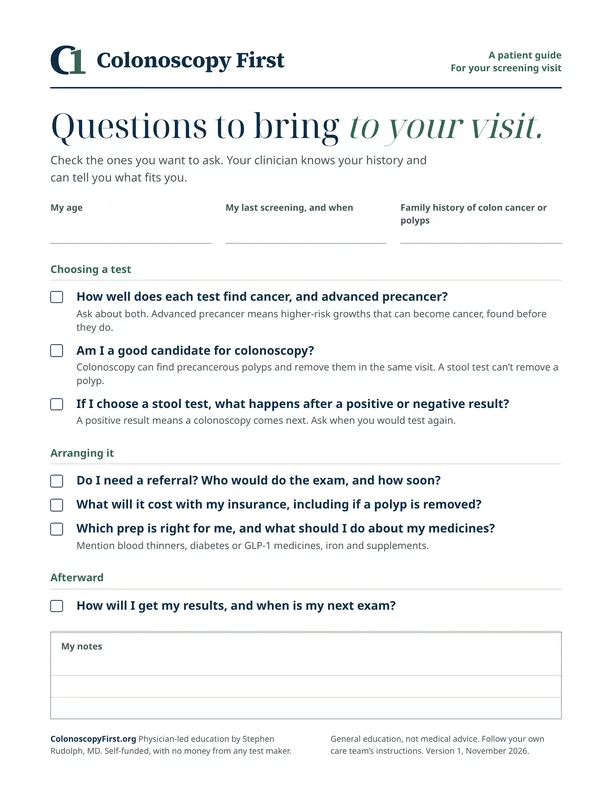
The patient handout: seven questions to check off, with blanks for age, last screening and family history. Useful on the counter at check-in.
One page · Version 1 · November 2026
Colonoscopy First is a physician-led education campaign. I pay for it myself; no test maker or device company funds it. Every study it cites is reviewed on the evidence page with its findings, its limits and its funding, including the studies that favor stool testing.
“Colonoscopy first” is this campaign’s position for average-risk adults who are due, able and willing, not a guideline. Guidelines recommend several tests, and a patient who completes a stool test on schedule is well served. I would simply like them to choose knowing what each test can and cannot do.
Corrections, a different format, or a question: get in touch.